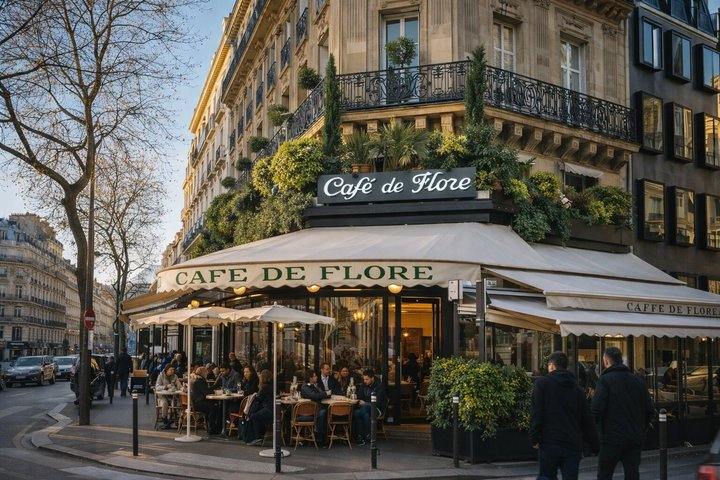
Some quartiers ask to be conquered; Saint-Germain-des-Prés asks only to be strolled. This is our favourite shape for a slow Left Bank afternoon: a gentle arc from the oldest church in Paris down to the river, then back up into the trees, with the pauses built in on purpose. Bring comfortable shoes and no agenda.
Begin at the Church
Start beneath the bell tower of the Église Saint-Germain-des-Prés, the oldest church in Paris, whose stones have watched the neighbourhood for a thousand years. Step inside and give your eyes a moment to adjust: the painted columns, the deep blues and golds, ask for slowness the way a whisper asks you to lean in. Ten quiet minutes here set the tempo for the whole afternoon. When you come back into the light, resist the urge to march off. Stand a moment in the little square beside the church and let the boulevard hum without you.
Two Cafés, Two Legends
Across the way wait the two most storied cafés in Paris. Café de Flore is where Sartre and Simone de Beauvoir wrote through whole winters as if the banquettes were their office. A few steps along, Les Deux Magots poured coffee for Hemingway and the Surrealists between their arguments about art. Choose one (we will not referee), take a table, and order something simple. The great luxury of a Paris café is that the table is yours for as long as you like; no one will hurry you. Let the boulevard do the moving for a while.
A Quiet Detour: Place de Furstemberg
Behind the church hides one of the gentlest squares in Paris. Place de Furstemberg is barely a square at all, more a pause between buildings, with its little cluster of paulownia trees around an old lamppost. The painter Eugène Delacroix kept his last studio here, now the Musée National Eugène-Delacroix, and it is easy to see why he chose it: the light is soft and the noise stays away. This is the sort of detour we build whole tours around. Nothing to tick off, nowhere to queue, just a corner that asks you to stand still for a minute.
The Cobbles of the Cour du Commerce Saint-André
Wander east and slip into the Cour du Commerce Saint-André, a cobbled passage from the eighteenth century running between Boulevard Saint-Germain and the rue Saint-André des Arts. The cobbles are uneven, which is a blessing: they make hurrying impossible. Old shopfronts lean close overhead, and halfway along you pass the back rooms of Le Procope, which has been serving Parisians since the seventeenth century, when Voltaire was among the regulars. Take the passage slowly, twice if you like. It is short in metres and long in atmosphere.
Rue de Seine, Then the River
Turn toward the water and let the rue de Seine draw you north. This is gallery country, and window-shopping for art is one of the neighbourhood's quiet pleasures: paintings, drawings, curiosities you may never buy and will happily remember. The street delivers you to the Seine and to the Pont des Arts. Walk to the middle of the pedestrian bridge and stop properly, elbows on the rail. The Louvre stretches along the far bank, the Île de la Cité gathers the river to the east, and for once in Paris there is no traffic, only footsteps. This is a bridge made for lingering.
The Dome of the Institut de France
At the Left Bank end of the bridge stands the Institut de France, its dome and curved wings composed as neatly as a well-made sentence. This is the home of the Académie française, guardian of the French language since the seventeenth century, and the façade alone is worth a slow minute of your afternoon. Then drift along the quai, where the green boxes of the bouquinistes hold old prints and older novels. Before you leave the river, turn around once. The dome looks its best from the middle of the bridge, framed by water and sky.
Finish Among the Trees: the Medici Fountain
Amble south along the rue de Seine and then the rue de Tournon, as the streets grow calmer and the shopfronts more bookish, until the gates of the Luxembourg Gardens appear. Inside, claim one of the green metal chairs, a Parisian birthright, and carry it to the Medici Fountain. This long, shaded basin, created for Marie de Médicis in the seventeenth century, is where the garden keeps its coolest air and softest light. Plane trees lean over the water and nobody speaks above a murmur. Sit until the afternoon dissolves. There is no better full stop to a Left Bank day.